
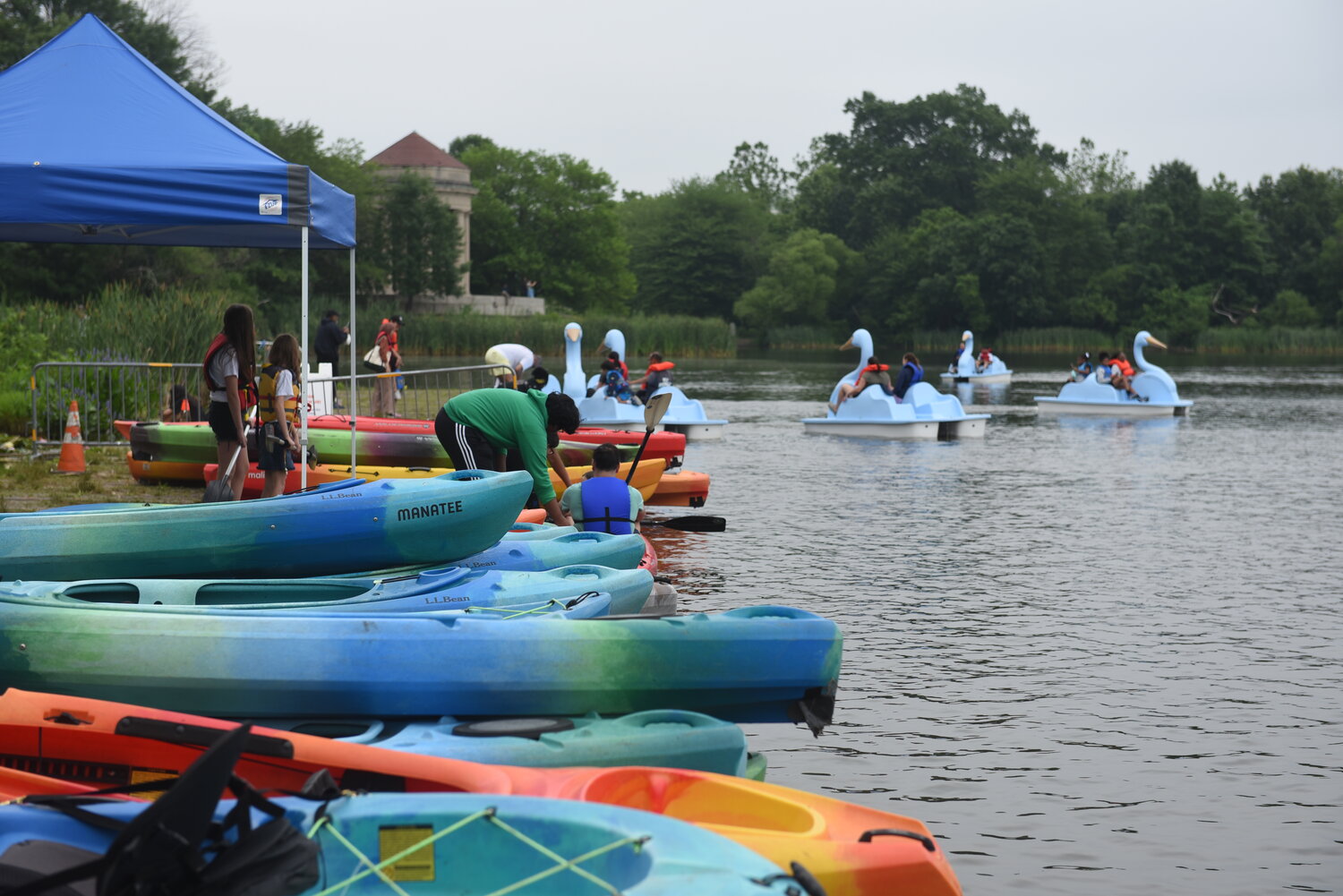


Yazmine Acosta didn’t know it, but the paddle she held in her hand was shaped like a key to the past, and just maybe the future as well. On an unseasonably cool Saturday during one of this spring’s stretches of wet weather, Acosta, a 14-year-old from South Philadelphia, greeted visitors at a lakeside dock in Franklin Delano Roosevelt Park, just across Broad Street from the Wells Fargo Center. Her slender arms outstretched, she demonstrated how to swoop a paddle’s ends in and out of the water in a figure-eight fashion, instructing people twice her size and three times her age on proper kayaking technique.
Two years earlier, Acosta had never been in a kayak. In fact, at that point, she barely knew activities such as kayaking existed, especially so close to the boxed-in environs of her South Philly block. But when she saw fliers at her school for Discovery Pathways, a nonprofit with a mission to get more Philadelphians paddling on local waterways, she decided to try kayaking.
“I’ve learned so much about watersheds. I learned how to kayak properly. I even learned how to fish for the first time,” Acosta said from the dock. “I get to actually breathe air for once instead of just being cramped in a house.”
It wasn’t that long ago that Philadelphians regularly took to FDR’s lake — along with many of the city’s other waterways — to recreate. The lake was formed during an initial landscaping of FDR Park by the Olmsted Brothers in the 1910s, and historical photographs show hundreds of people at a time swarming its banks and wading into its waters to swim. The activity used to be so popular that residents of nearby neighborhoods began calling the park “The Lakes,” a history recent enough that it is remembered by some older visitors, according to Adam Forbes, founder of Discovery Pathways.
But Forbes isn’t focused on collecting memories of a bygone era. Instead, he’s interested in making new ones for current and future generations of Philadelphians who want to boat, fish, and perhaps one day swim in the city’s waterways. Often, though, he feels like he’s fighting to break the logjam of the status quo.
“It’s a city of rivers. There are lots of possibilities to get out on water. But there are very few established access points,” Forbes said. “And the biggest thing we deal with historically is people think of the Schuylkill and Delaware as dirty. Even the lakes at FDR, a lot of people just think the water is polluted, dirty, and unsafe.”
Forbes is part of a band of advocates in the city who envision a Philadelphia with far more water-based recreation than currently exists. They picture waterways with less pollution and more boat launches, where all forms of water-based recreation are within reach geographically and financially for large numbers of the city’s residents.
Stefanie Kroll is director of Riverways, a consortium of groups (including Discovery Pathways) devoted to connecting people to the region’s waterways. She said Philadelphians who want to kayak often travel outside the city to do so. She wants to create the right conditions for them to stay.
“We need access points, and we also need signage … routes that we could publish, the same way as the Circuit Trails [network for bicyclists],” Kroll said. “People could leave a car and grab a bus, paddle back, you know?”
But some advocates say they feel power players in the city don’t prioritize water-based recreation as much as they do. At best, they reason, that’s because officials and government offices may be focused elsewhere in a big, poverty-stricken city with a multitude of competing priorities and not enough money to pay for them all. But others suspect something else: a desire to avoid the topic altogether, lest more attention be drawn to the condition of the city’s rivers and creeks.
“The official position is, or attitude is, don’t go on the water. Don’t go in,” said Tim Dillingham, executive director of the American Littoral Society, a nonprofit focused on cleaning up waterways in the Delaware River watershed. “To me, that is not the appropriate position for public agencies to take. The best interest of the public lies in clean water, and they should be doing everything they can to engage.”
Numerous Philadelphia city agencies, including the Office of the Mayor, Parks & Recreation, the Department of Public Health, the Office of Risk Management, and the Philadelphia Police Department Marine Unit, declined to be interviewed or provide answers to written questions for this story.
Kelly Anderson, director of the Philadelphia Water Department (PWD) Office of Watersheds, says she has fond memories of family boat outings on the Delaware River while growing up in Riverton, New Jersey, just across from Northeast Philadelphia. She remains an “advocate” for river access and said PWD has worked with numerous nonprofits to promote free fishing days, build a kayak launch along the Schuylkill, and support other programming.
She rejects the idea that there is a binary decision to be made by PWD or other agencies around water recreation. The Water Department has worked to measurably improve the quality of the city’s waterways throughout its existence and continues to do so, she said. But, she added, PWD must be judicious with ratepayers’ money and prioritize public safety.
“I’m coming at it from the perspective of a risk manager who is responsible for protecting public health and managing water quality,” Anderson says. “We have to be very clear-eyed about the risks that come from recreational uses.”
Councilmember Curtis Jones Jr., whose district includes both the Wissahickon Creek and Schuylkill River as it passes through Fairmount Park, has previously warned of the dangers of swimming in the city’s waterways, going so far as to call for filling in a notorious swimming hole with rocks. But he also says he views balancing industry and river recreation as an environmental justice issue. In 2018, Jones was among several councilmembers who participated in a Dad Vail rowing challenge on the Schuylkill. That led to a joint initiative with Temple University to get local kids, some of whom ended up with college scholarships, into rowing and crew.
“I think the river has the ability to transcend race, transcend economic classes and give people exposure not only to different views of the city, but different people from around the city,” Jones says.
This is the first installment in a multi-part story collaboration between the Chestnut Hill Local, GRID Magazine and the Delaware River Currents, produced with the support of the Philadelphia Journalism Collaborative, a coalition of more than 30 local newsrooms doing solutions reporting on things that affect daily life. Follow at @PHLJournoCollab.




