More than 100 people gathered at Pastorius Park last Thursday to celebrate a significant milestone in the park’s history.
The ceremony hosted by Friends of Pastorius Park marked the launch of the Paul W. Meyer Northeast Woods Restoration Project, an ecological effort in the northeastern woodlands bordering Shawnee Street and West Hartwell Lane. FoPP plans to revitalize the health of the two-acre section by planting native species.
The project, which is expected to cost nearly $300,000, commemorates late horticulturalist Paul W. Meyer, who helped spearhead Pastorious Park’s 100-year …
This item is available in full to subscribers.
You can also purchase this individual item for $1.50
We have recently launched a new and improved website. To continue reading, you will need to either log into your subscriber account, or purchase a new subscription.
If you are a digital subscriber with an active subscription, then you already have an account here. Just reset your password if you've not yet logged in to your account on this new site.
If you are a current print subscriber, you can set up a free website account by clicking here.
Otherwise, click here to view your options for subscribing.
Please log in to continue |


More than 100 people gathered at Pastorius Park last Thursday to celebrate a significant milestone in the park’s history.
The ceremony hosted by Friends of Pastorius Park marked the launch of the Paul W. Meyer Northeast Woods Restoration Project, an ecological effort in the northeastern woodlands bordering Shawnee Street and West Hartwell Lane. FoPP plans to revitalize the health of the two-acre section by planting native species.
The project, which is expected to cost nearly $300,000, commemorates late horticulturalist Paul W. Meyer, who helped spearhead Pastorious Park’s 100-year restoration plan and served as the F. Otto Haas executive director of the Morris Arboretum & Gardens.
“Because of Paul’s vision, this moment has arrived, finally,” FoPP treasurer Fabrizio Franco said at the ceremony, which took place in front of project site by Roanoke Street.
The launch follows years of fundraising, grant-writing and planning by FoPP members and other stakeholders. Friends of Pastorius Park secured the funds to launch the project earlier this year through the help of a state grant, public donations and a matching grant from a park neighbor and the Wyncote Foundation. Volunteers planted the first 50 understory trees in October.
Before the multiyear effort began, the northeastern woodlands had been largely untouched for many years, becoming overrun with invasive species and soil erosion. The land was donated to the city by Dr. George Woodward in the early 20th century and Friends of Pastorius Park formed in 1987 due to the park’s serious decline.
FoPP had always found a project of this scale “difficult to tackle” and “a little bit intimidating,” Franco said. That changed when Meyer and his wife, Debbie Rodgers, moved to neighborhood and offered their expertise, he said. Meyer worked with FoPP president Tracy Gardner, landscape architect Rob Fleming, park steward James McNabb and other volunteers to combat invasive species throughout the grounds.
“He showed us immediately how it was possible to start restoring this park…and then showed us that it was possible to start doing something here in this area,” Franco said.
For the project, FoPP will install 160 trees, 700 shrubs, 11,000 grasses and sedges, as well as thousands of seeds this year, Franco said.
The plan, which was crafted by landscape designer Bob Gray, aims to restore the woodland’s community of native species, solve erosion problems and improve the visitor experience.
FoPP will convert the woodlands into a biodiverse oasis to reduce the spread of invasive species and generate native pollinator, bird and plant populations, he said. The project will increase the number of tree species by 50%, the number of native shrubs by five times and the herbaceous community —consisting of perennials, ferns, grasses and sedges — by 10 times. The area will also have four-season plants and species resistant to climate chance impacts like drought.
The plants will strengthen the soil to prevent erosion and reduce stormwater runoff during intense storms. The soil will help capture and clean stormwater that flows into the pond and Cresheim Creek. For visitors, there will be new pedestrian walkways and signage explaining the species and park’s history.
“This project really, in the end, seems to be a compilation of the principles that Paul believed,” Gray said. “At its core, it’s reestablishing a woodland plant community, but it may be much more. As evidenced by the progress to date in this gathering itself, it appears to be a catalyst for people to come together around transforming a neglected corner into a community jewel. I think he would be pleased.”
Alison Thornton, director of strategic partnerships at the Morris Arboretum & Gardens, reflected on Meyer’s legacy and contributions to the field of horticulture, Morris and Pastorius Park. By dedicating the project to Meyer, FoPP is honoring Meyer’s belief “that stewardship is a shared responsibility, and that the work that we do today should benefit generations we may never meet,” she said.
“All of us here, in one way or another, have been lifted by Paul’s contributions to this community, by his leadership, his knowledge, his kindness, and his belief in the power of trees and their crucial role in both ecology and human connection,” Thornton said, as sunlight broke through the clouds.
State Rep. Tarik Khan (D., 194th) and state Sen. Art Haywood (D., 4th) presented Gardner and Franco with a symbolic check for the state grant that helped propel the project’s launch. FoPP was one of the two recipients in Philadelphia to receive a grant through The Pennsylvania Department of Environmental Protection’s Growing Greener Plus program, earning a $170,042 reimbursement grant.
“I’m glad that we were able to provide some level of support from the Commonwealth, to go along with the other organizations that provided support. But what I have heard today is a clear testament to what actually is possible. Please build on that hope,” Haywood said.
Khan said he and Haywood will continue investing in Pastorius Park and partnering with the Friends group.
“I am so excited and so grateful that you’re all part of this process, that you all stay involved, that you all continue to invest in Pastorius Park and make it one of the greatest parks we have here in the Commonwealth,” he said at the ceremony.
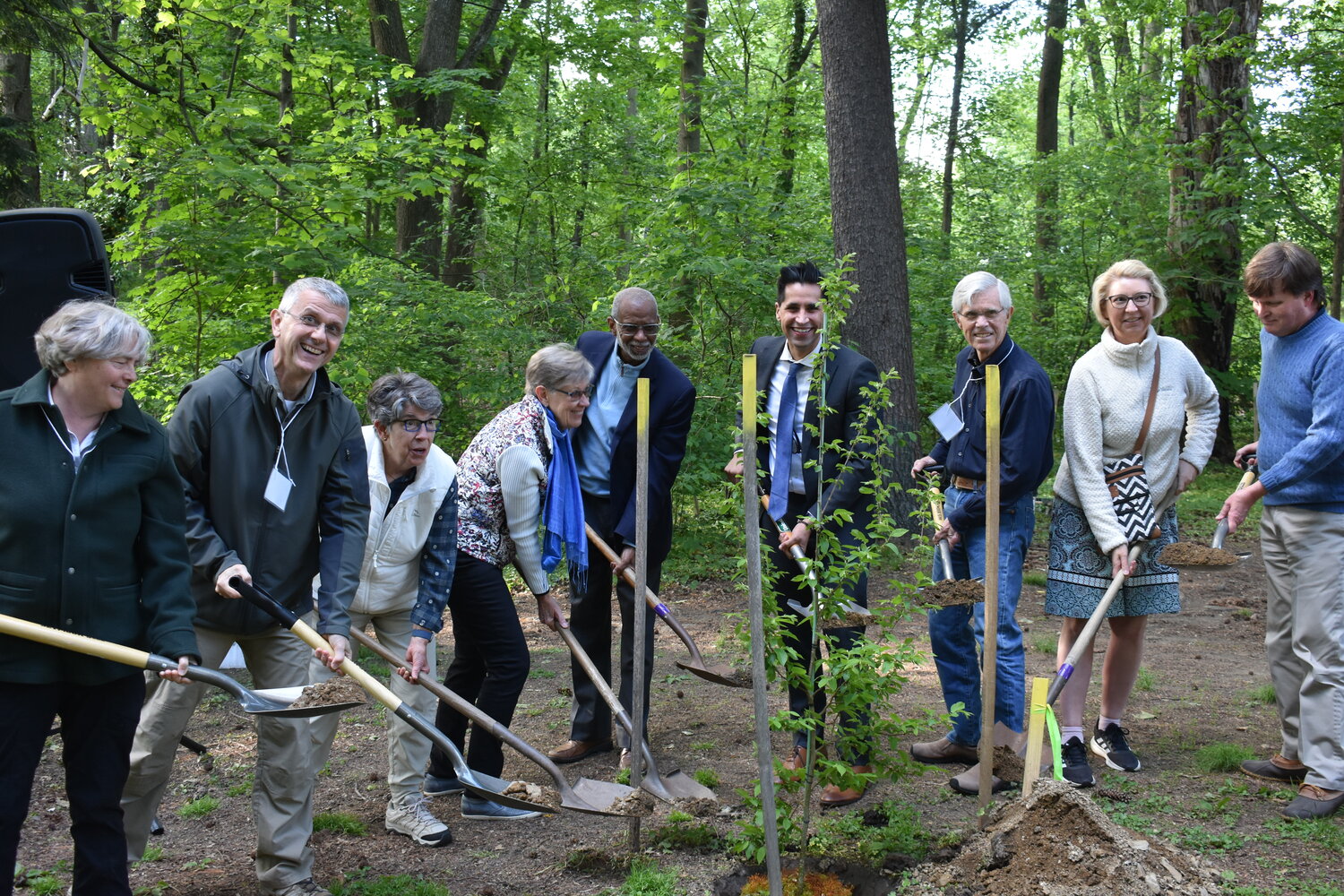
The event concluded with a ceremonial planting of a hornbeam tree.
FoPP will contract with a landscaper this summer and the current goal is to install the project elements in September and October, Franco said.
At the event, Gardner thanked the project’s major supporters: City Councilmember Cindy Bass, who was represented at the event by her chief of staff; the Philadelphia Parks and Recreation Department; the Chestnut Hill Community Association; the Chestnut Hill Conservancy; the Chestnut Hill Business Association; the Chestnut Hill Community Fund; the Chestnut Hill Rotary Club, and Philadelphia Committee of the Garden Club of America.



