Henry H. Houston Elementary School in Mt. Airy welcomed Sarah Meller, a Holocaust survivor, to speak to eighth grade students on April 16.
It was a harrowing story of narrow escapes and cruelty, but also courage and heroism.
Meller shared her experiences through a program from the Holocaust Awareness Museum and Education Center in Elkins Park. According to Lise Marlow, the education director at the center, the organization brings survivors to schools to share their testimonials.
“When we host a program, we tell students that you are the last generation to meet a survivor, and once …
This item is available in full to subscribers.
You can also purchase this individual item for $1.50
We have recently launched a new and improved website. To continue reading, you will need to either log into your subscriber account, or purchase a new subscription.
If you are a digital subscriber with an active subscription, then you already have an account here. Just reset your password if you've not yet logged in to your account on this new site.
If you are a current print subscriber, you can set up a free website account by clicking here.
Otherwise, click here to view your options for subscribing.
Please log in to continue |

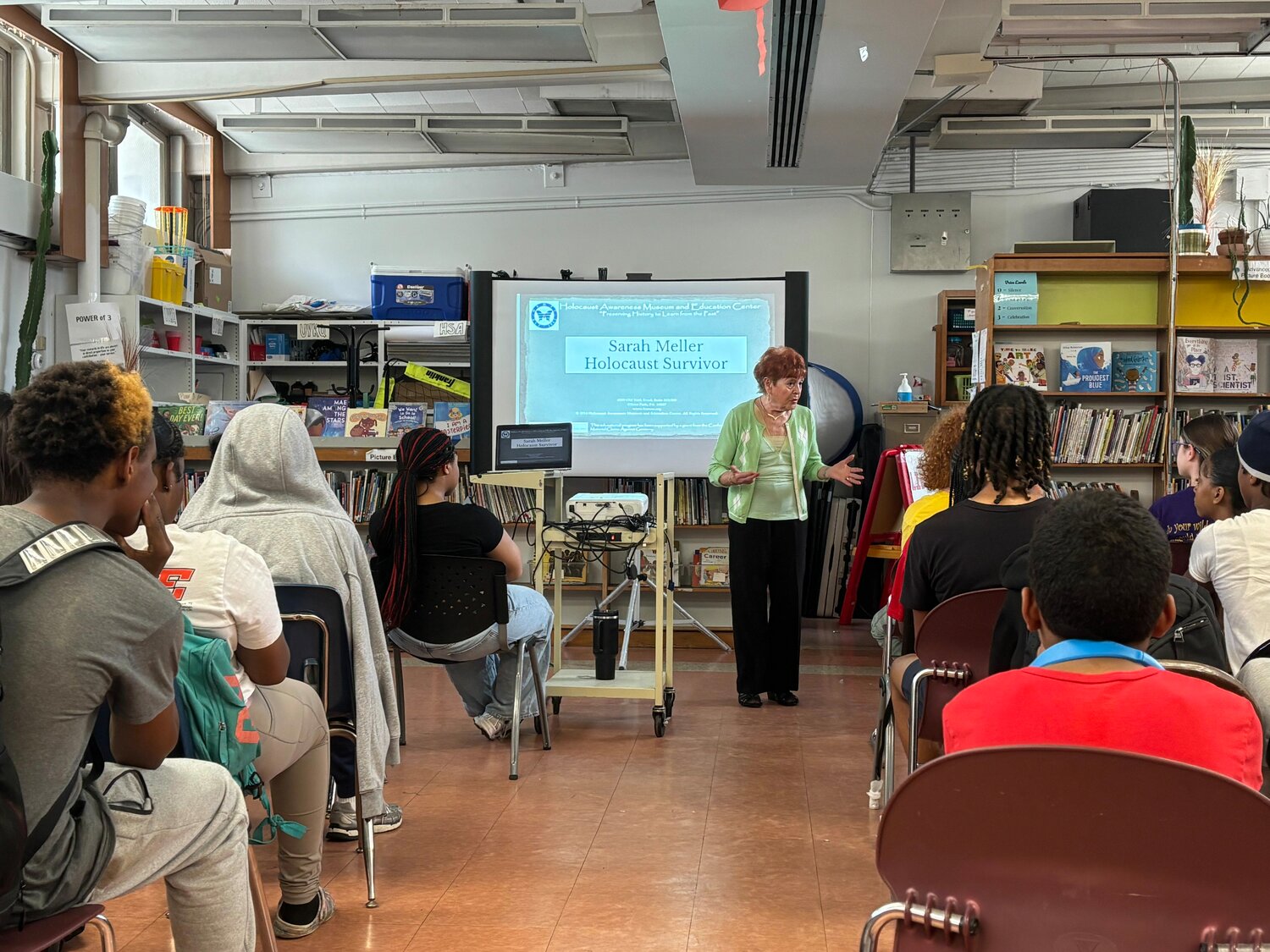


Henry H. Houston Elementary School in Mt. Airy welcomed Sarah Meller, a Holocaust survivor, to speak to eighth grade students on April 16.
It was a harrowing story of narrow escapes and cruelty, but also courage and heroism.
Meller shared her experiences through a program from the Holocaust Awareness Museum and Education Center in Elkins Park. According to Lise Marlow, the education director at the center, the organization brings survivors to schools to share their testimonials.
“When we host a program, we tell students that you are the last generation to meet a survivor, and once you hear a survivor’s story… it becomes your story to tell,” Marlowe said during the presentation. “It also becomes your responsibility to stand up and speak up to the Holocaust deniers of the world.”
Malina Covington, an eighth grader at Houston, learned about the speaker program as a member of the Commonwealth Youth Choir, which puts on an annual concert for Holocaust survivors. Covington brought the initiative to the attention of her teachers and, as Marlowe said, “how can you say no to that?”
Meller’s story
Meller’s inspiring story is one of great courage in the face of hardships. Born in Split, Yugoslavia — now Croatia — in 1933, Meller said she was “a happy child.” Along with her mother, father, brother, and two sisters, Meller attended synagogue on Friday and Saturday evenings.
However, when Germany invaded Yugoslavia in April 1941, things quickly began to change. Italian occupiers took over the schools, changed the language of the newspapers, and promoted anti-Semitic hatred. Meller only attended one day of first grade before being sent home because she was Jewish.
As a child, Meller was not fully cognizant of how the war was affecting her family’s life. She only knew that Yugoslavia was on edge.
“My father was reading a letter,” Meller recalled. “He was crying. I never saw my father cry. I asked him, ‘Dad, why are you crying?’ He sent me away because he didn’t want to upset the kids. Later, I realized why he was crying. He lost all his family — 64 members.”
On a Friday evening in the summer of 1942, Italian “Blackshirts” burst into the Split synagogue and beat everyone bloody. They also looted and burned religious texts and artifacts. Meller and her family were saved from the beating, only because a customer at her father’s store made them late.
When the Nazis invaded Split in September 1943, Meller and her family fled. Her father, brother, and older sister escaped to join partisan units and fight in the war. Meller said she was living in fear and begged her mother to flee. She began to practice escape routes in her house.
“We lived on the second floor,” Meller said. “I would jump down. I was practicing… My mom said, ‘Don’t do that! Do you want to break an arm?’ But I was practicing. If I would hear the Germans banging on our door, I would jump through the window and go away.”
Eventually, Meller packed a knapsack and left most of her belongings behind to escape to a farmer’s home. For five months, Meller, her sister, and her mother hid in silence in a tiny room. As the farmer grew increasingly worried, the family was forced to flee to Vis, an island in the Adriatic Sea, for three months.
Before long, Vis also became too risky. The family next headed to Mosor, a mountain range, to hide with a Yugoslavian partisan unit. The journey was harrowing, but Meller and her family were eventually rescued by a British ship. They traveled to a displaced persons camp in Italy, where they reunited with several other family members.
Meller and her family were among 1,000 Jewish refugees sent to Fort Ontario, a camp in Oswego, New York, through an initiative started by President Franklin D. Roosevelt. When the ship arrived in New York, Meller said the refugees were overjoyed.
“[Seeing] the Statue of Liberty was so meaningful,” Meller said. “We all prayed and thanked God for reaching this occasion to be here in the United States.”
When the war ended, the refugees at Fort Ontario were supposed to return to Europe. However, President Harry S Truman was persuaded to let them become U.S. citizens. Meller and her family eventually moved to Philadelphia, where she attended Benjamin Franklin High School. She met her future husband around the age of 18 and would go on to have three children and seven grandchildren.
Sharing her testimony
The attendees at the presentation were given the chance to ask Meller questions. Students asked about her older sister, Blanka, who was shot in the leg as a partisan fighter. Meller reunited with Blanka after the war.
Meller received another question about returning to Croatia. She said she has since been there twice, and even knocked on the door of her old family home and met the family currently living there.
Although Meller frequently presents her story, she told the Local it can still be difficult. However, she feels her message is important to share.
“If I talk about my mom, I get choked up. I do get emotional sometimes, but looking back, we were lucky because we survived and we didn’t go to a concentration camp,” Meller said. “We escaped because of good people. …It’s no good to hate. It’s good to love. We would have been dead, but people took chances.”
To learn more about Sarah Meller’s story, visit hamec.org or read “Sarah’s Survival” by Lise Marlowe.
Maggie Dougherty can be reached at Margaret@chestnuthilllocal.com.



